


Did you know that the oldest Jewish community in Europe is the Romaniotes, and that Jews have lived in Greece for more than 2,300 years? Or that just 10 years ago, all Yemenite Jews were forced to leave or convert? We combined some delicious food with these interesting history lessons to create Goucher Hillel’s exciting new program, World Jewry Shabbat. Students and staff come together to prepare a meal while learning about the Jewish history of various areas of the world. The group meets on a Thursday evening and shares their delicious spread the following day for Shabbat dinner.
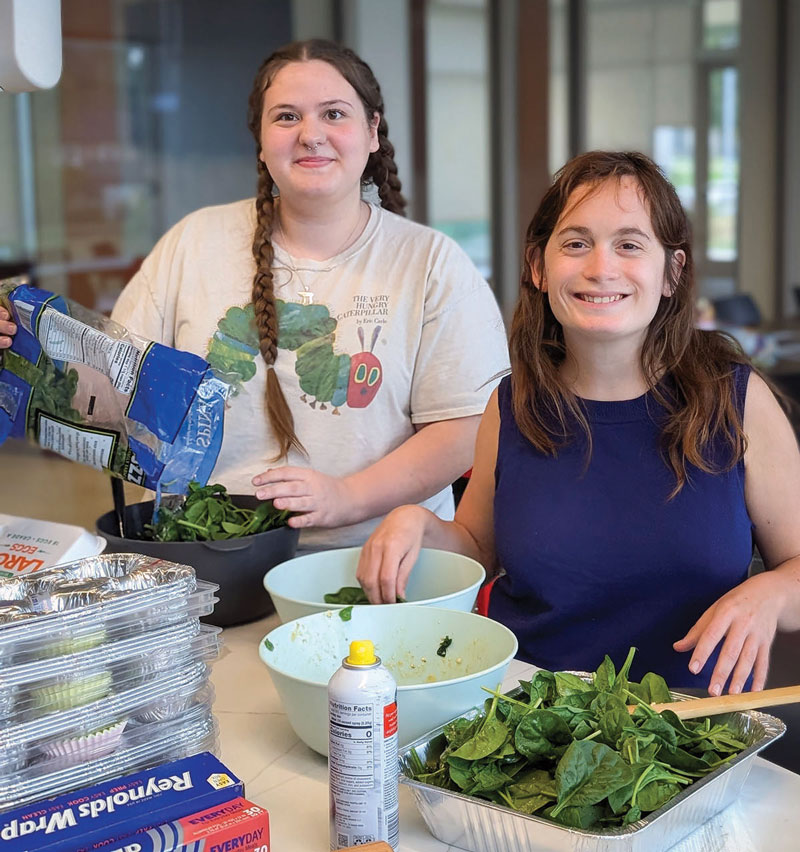
The Jewish history and cuisine of Greece was the focus of one event. The group prepared Greek specialties such as melitzanna salata (eggplant salad), fritada de spinaka (spinach fritada), kassate (cheese pastries), and mylo tou koutalios (apple preserves). They learned that after the expulsion of Jews from Spain in Portugal in the 1490s, many of these Sephardic Jews fled to Greece and the Romaniote communities. Due to their different customs and languages, the two remained separate. The Spanish-speaking Sephardi Jews eventually combined their native language with words from Greek, Turkish, Arabic, and Bulgarian, creating a new language— Ladino. The Romaniote community continued to speak Greek.

Goucher alums Rivka Glazer ’95 and her sister, Miriam ’01, joined their father at the Hillel event to share their family’s history in Greece during World War II. Rivka’s mom, Rachel Velelli Glazer ’70, was born in Greece. Nine members of her family were hidden in a remote mountain village winery by a family friend for 12 months during the war. Although the area was bombed by the Germans twice, they endured and were among the few from their community who survived the Holocaust. Rivka reminisced about her childhood and how “food was always a way for us to connect with our Greek heritage.”
The second program delved into the culture of Yemenite Jews through delicious recipes, including lentil soup, stuffed grape leaves, zhoug, and Yemenite salad. As students worked together chopping and mixing, they learned that Yemenite Jewish roots can be traced to Biblical times. Grievously, Jews were persecuted for nearly 1,000 years enduring racist laws, including one that forbade them from defending themselves if being attacked by a non-Jew! Beginning in the late 1800s, Jews began to emigrate in large numbers despite rules that forbade their movement out of the country. Nearly one-third of the Yemenite Jewish population, approximately 16,000 people, made Aliyah between 1919 and 1948. Unfortunately, life became more intolerable for those that remained. Throughout the ensuing years, Israel, Great Britian, and the United States evacuated Jews. Due to violence, conversion laws, and the threat of imprisonment or death, the number of Jews believed to remain in Yemen today is between one to five.
Goucher student Josie Grosser ’28 was inspired to attend Global Jewry Shabbats so that she could learn more history, spend time with other students, and take a break from her normal school routine. Participants enjoyed cooking and celebrating Shabbat with their peers. At the conclusion of each event, students were provided with a packet of information, including the recipes and a brief history so they can share the information with their family and friends.